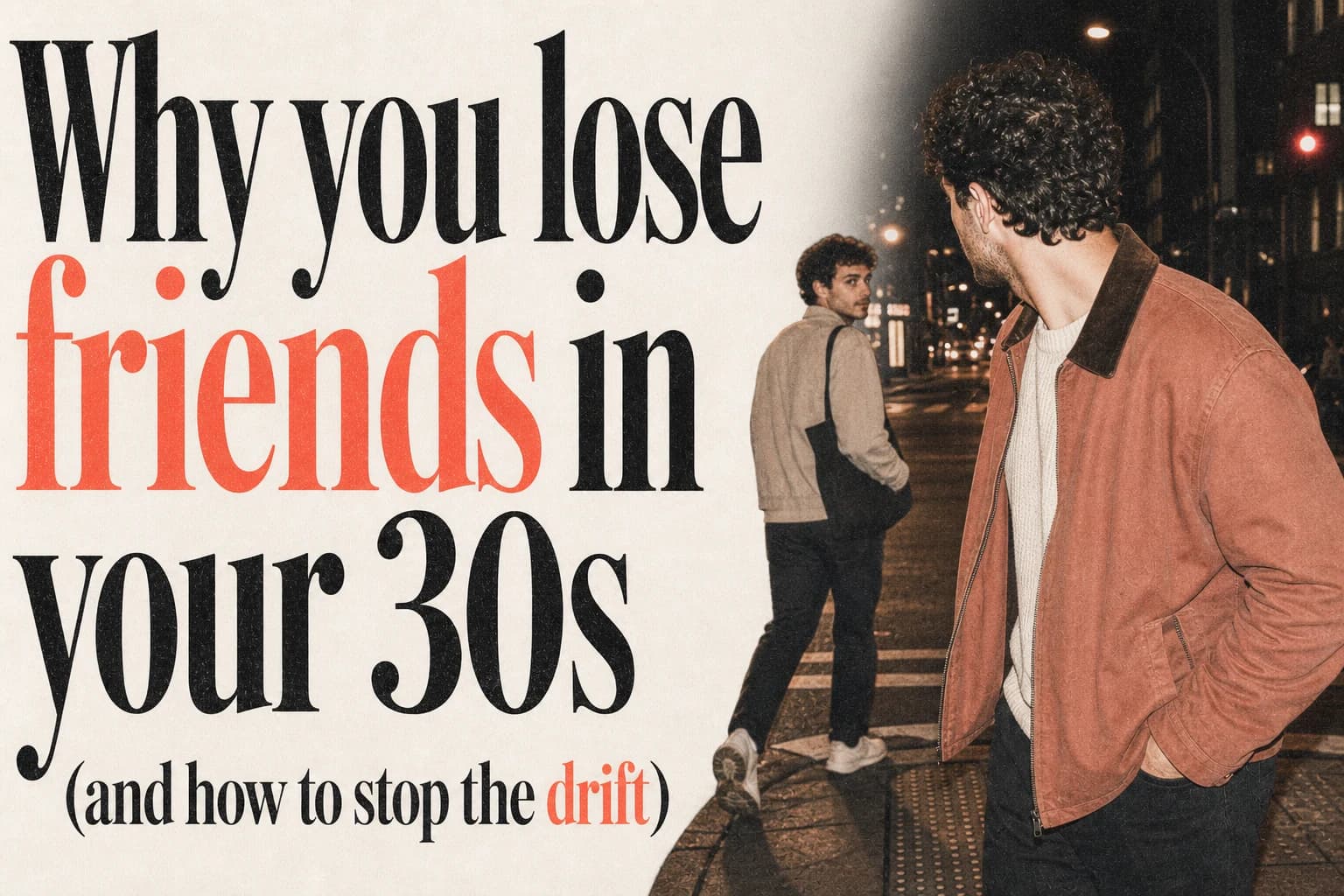
Why you lose friends in your 30s (and how to stop the drift)
Nobody warns you about this one. You hit your thirties and your friendships start thinning out. Not with fights. Not with betrayals. They just fade, like a radio station on a long drive.
You didn't do anything wrong. Neither did they. Here's what's actually happening, and what to do about it.
School was a friendship machine and you didn't know it
For the first twenty five years of your life, the world put your friends in a room with you. School did it. Then university did it. Then your first jobs and share houses did it. You saw the same people every day without either of you lifting a finger. Friendship felt free because the hard part, showing up in the same place, was being done for you.
Then, one by one, the rooms disappear. People pair off. People move suburbs, then cities, then countries. Kids arrive and eat every spare evening for a decade. Careers get serious. And suddenly a friendship that ran on automatic needs to be run by hand, and nobody told either of you that the switch flipped.
That's the whole mystery. Your thirties don't make you worse at friendship. They just remove the machine that was doing it for you.
Drift is the default, not a decision
Here's the part that helps to know. When a friendship fades, it almost never means someone chose to end it. Drift is simply what happens when two busy people both wait for a natural moment to reconnect, and natural moments stop occurring, because the room you shared is gone.
Both of you notice. Both of you feel a bit sad about it at midnight sometimes. Both of you assume the other person has moved on. Both of you're wrong. I've never met anyone who received a message from an old friend and thought less of them for sending it. Not once. The message that feels risky to send is almost always a relief to receive.
So the question isn't why did we drift. Everything drifts. The question is which friendships you're going to run by hand now, and how.
How to stop it
Pick your people on purpose. You can't hand-run seven hundred connections. You can run fifteen. Write the actual list of who you want in your life at forty and fifty. This feels strange to do. Do it anyway. Unchosen friendships get whatever time is left over, and there's never time left over.
Shrink the unit of contact. The drift survives on a lie, the lie that reconnecting requires a dinner, a call, a proper catch up you'll organise soon. It doesn't. "Saw this and thought of you" is contact. "How is your dad doing" is contact. Small and regular beats big and never. The dinner can grow out of the messages. It will never grow out of silence.
Stop trusting your memory. The reason you haven't messaged isn't that you don't care. It's that nothing reminds you. There's no classroom, no office kitchen, no feed. Your head won't do it, heads never do. So the dates, the job changes, the stuff they're going through, all of it has to live somewhere outside your skull, and something has to tap you on the shoulder at a moment you can actually type.
Someone has to go first. Be the one. Every faded friendship is two people waiting. Going first isn't needy. It's a gift, and it's rarer than it should be.
The tap on the shoulder
The first two steps are yours. The third is why I built Companion.
It lives in Telegram. You tell it about your people, a voice note while walking is enough, and it remembers what your head won't. Birthdays. The new job. The rough patch. Then it nudges you at the right moment, helps you find the words if you want them, and gets out of the way. It never messages anyone for you. It isn't a feed. It's the room you all used to share, rebuilt as a small tap on the shoulder.
Your thirties took away the machine. Build a smaller, better one, and keep your people.
Common questions
Frequently asked questions
Why do friendships fade in your 30s?
The shared rooms that once made friendship automatic disappear. Work, moves, partners, and children mean the relationship now has to be run by hand.
Is losing friends in your 30s normal?
Drift is the default when two busy people both wait for a natural moment to reconnect. It usually doesn't mean either person chose to end the friendship.
How do I stop drifting away from friends?
Choose the people you want in your life, make contact smaller, and stop relying on memory. Someone has to go first, and a short message is enough.